
Your Story Belongs Here
Whether you were a camper, an aide, a counselor, an educator, or a camp parent or sibling, we want to hear your Northrop memories!
Tell Us Your Story
The history of Northrop Camp isn't just in the archives — it's in the memories of everyone who has ever been here. Share it with us, and help us build a living record of everything this place has meant.
In 2026, ARNMC is collaborating with public humanities producer Jen Myronuk & STEM on Stage to launch the Northrop Camp History Project. The digital archives portal page and online interviewing studio will be linked from this section. Stay tuned for more announcements!
Share a Memory
Your story may be featured on our site (with your permission).
Stories from the Community
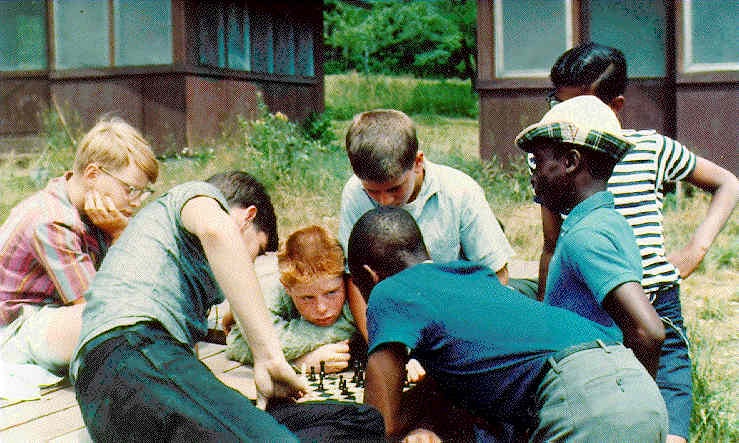
"I was at Northrop twice, at ages 11 and 14. My brother and sister also were campers there. I remember my sister Cory saying, “I’m so glad we’re poor so we could go to Northrop!” My parents were separated and my mother worked full time. I needed the summers to be mended. Counselors blended their love for us with their love for nature to provide an irresistable source of nourishment. They taught us to see, appreciate, love and incorporate every living thing. I learned that the rain, wind, stars and moon were part of me too. My Northrop experience has served as a source of strength, joy and comfort each day of my life. The woods still call to me . . ."
"Being a camper at Northrop was a wonderful experience. The setting was beautiful, the programs were mind-opening, and the people were great! There was real comraderie and a true spirit of teamwork in an atmosphere that made learning about science and nature so much fun! I still show my kids what wintergreen looks like and how to find salamanders under rocks, which I learned from my camp days! I learned to dive and swim several new strokes at camp. I fondly recall packing a bedroll and hiking about two miles to camp outside for a night. It was a terrific growth experience that I'll never forget! (And it's the first time I ever ate s'mores. Yum!)"
"One day, ... returning from a nature walk, I overheard a young camper’s voice raised in protest: “Aw, let the poor thing go, Francie! If you take him back to camp, you’ll only forget to feed him half the time; and anyhow, a caterpillar doesn’t like being kept in a cage...!” It was Jane speaking; ... a fortnight earlier [she] had wanted to test the powers of a “burning glass” on a swarm of foraging ants."
"Here then, is one good reason for the study of nature: its potency in the building of good citizenship. The child who finds that his prejudice against certain kinds of creatures — in this case, insects — vanishes when he becomes better acquainted with them, is more likely to carry this lesson over into his relationships with human beings and so become more tolerant of his fellow man. The child who discovers that each kind of creature has its own special function in nature’s plan ceases to regard the lesser forms of life as insignificant; in recognizing their importance in relationship to the whole, he develops respect for them and thus acquires a budding sense of true democracy."
"Each camper had a nature project for the summer. My first project was on useful wild plants and my second . . . was on identifying wild flowers. These projects extended into a lifelong hobby and career. I am now a plant propagator for the New Jersey Native Plant Society; there are currently two species of endangered plants on my window sill . . ."
"Dr. Grace Petersen was the very dedicated nature director during my camp days. She . . . was a hard lady to stump but I did give her a hard time when I asked the names of some of the smaller mosses, various flies, and non-sporulating slime molds. Other than that she seemed to know just about all the kinds of plants, animals, minerals, and stars. . . Dr. Petersen was the first person to show me a slime mold . . . She mentioned that this blobby giant amoeba we saw in the woods would move and that we could detect movement if we were to put a stick or some other marker on the log where it was migrating and come back several hours later (slime molds crawl about one inch in two hours). Later in college I found that one of my biology teachers, Dr. O.R. Collins, did his research on slime molds. Since my curiosity was already aroused, I carried out undergraduate research with Dr. Collins, got out a series of publications, a Master’s in botany, and a Ph.D. in microbial genetics . . ."